
Illuminating the Depths: How Underwater Fishing Lights Are Revolutionizing Nighttime Angling
For decades, the age-old adage “early bird gets the worm” has governed the fishing world. Anglers have risen before dawn, chased the morning bite, and packed their rods away as the sun dips below the horizon. But a quiet, glowing revolution is taking place beneath the surface, rewriting the rules of when and how we fish. At the heart of this transformation are underwater fishing lights—not the clunky, battery-draining relics of the past, but sleek, high-intensity, spectrum-specific beacons that are turning the nocturnal ocean into an angler’s playground. This is not just about seeing in the dark; it is about fundamentally altering the marine food chain in a localized area to create a feeding frenzy that is as predictable as it is spectacular.
The Biological Catalyst: Why Light Equals Bite
To understand why underwater fishing lights are so effective, one must first understand the microscopic world of plankton. Phytoplankton, the base of the oceanic food web, are photosynthetic organisms. They are naturally drawn to light sources, particularly in the blue and green spectrum, which penetrate seawater most efficiently. When you deploy a high-quality underwater fishing light, you are not merely illuminating the water; you are instantly cultivating a dense patch of plankton.
This plankton bloom acts as an irresistible dinner bell. Small baitfish—such as sardines, anchovies, and silversides—swarm to the concentrated food source. They are quickly followed by predatory game fish like snapper, striped bass, walleye, and tarpon, who see the aggregation of baitfish as an easy buffet. Within thirty minutes of dropping a light, a barren patch of water can transform into a thriving, chaotic ecosystem. This is the core innovation: underwater fishing lights do not just help you see the fish; they actively summon them from the surrounding darkness, effectively shrinking the vast ocean into a manageable, visible arena.
Beyond Illumination: The Spectrum Advantage
The novelty of modern underwater fishing lights lies not in the brightness, but in the color. While white lights are effective, they often spook larger, line-shy predators. The cutting-edge technology in 2026 revolves around specific wavelengths.
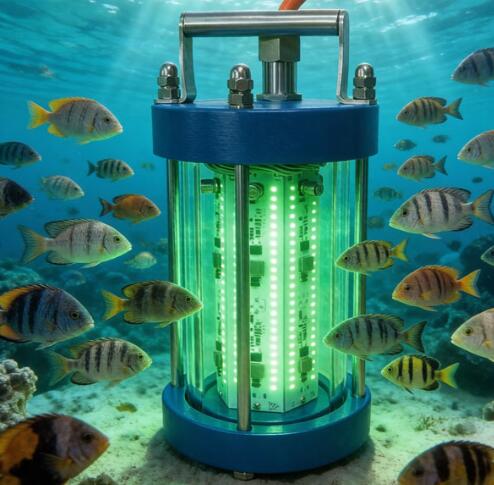
Green Light (510–530 nm): This is currently the gold standard. Green light penetrates freshwater and murky saltwater better than any other color. It is less abrasive to the eyes of large predators, making them bolder and more willing to enter the illuminated zone. Furthermore, green light has been shown to attract a broader range of baitfish without attracting stinging jellyfish or undesirable bycatch, which are more attracted to white or blue.
| underwater fishing lights |
Blue Light (450–470 nm): In crystal-clear offshore waters, blue light reigns supreme. It penetrates the deepest and mimics the natural down-welling sunlight, making it ideal for deep-dropping for species like grouper or swordfish.
UV/Black Light: An emerging trend is the use of UV lights, which exploit the fluorescent properties of certain baitfish. When a baitfish passes through a UV beam, its scales flash neon, acting as a super-stimulus that triggers a predatory strike response in game fish.
By selecting the correct spectrum, anglers can now “tune” their environment, targeting specific species while filtering out unwanted ones. This level of control was unthinkable a decade ago.
Functionality: More Than Just Attraction
The utility of these lights extends far beyond merely attracting fish. The modern units are engineered for versatility and resilience:
Submersible Durability: Constructed from aircraft-grade aluminum and polycarbonate lenses, these lights are designed to withstand the crushing pressures of deep water (often rated to 500 feet) and the corrosive nature of saltwater. They run cool to the touch, preventing burns when handling the line near the light source.
Battery Efficiency: With the advent of lithium-ion and high-capacity marine batteries, a single charge can power a high-lumen LED array for 8 to 12 hours. Many units now feature smart sensors that adjust the brightness based on ambient light and battery level, ensuring maximum efficiency throughout the night.
Horizontal vs. Vertical Deployment: Novel designs include conical lights that project a broad horizontal beam to attract fish from a distance, and downward-facing “spotlight” rigs used for vertical jigging directly beneath the boat. There are even portable, buoy-mounted lights that can be tethered to a kayak, allowing solo anglers to fish hands-free in shallow flats.
The Strategic Angle: How to Use Them Effectively
Using underwater fishing lights is an art. The most successful anglers do not simply throw the light overboard and wait. They use the light as part of a dynamic system.
The "Edge" Strategy: Place the light just off the edge of a drop-off or structure. The light will attract bait to the shallows, while the predators will lurk in the darker depths at the edge of the illuminated circle, picking off stragglers. Casting your lure into the dark zone and retrieving it through the light mimics a fleeing baitfish, triggering vicious strikes.
The "Suspended" Setup: For deep-water species, suspend the light 5 to 10 feet below the surface. This creates a "halo" effect that attracts bait from below, pushing them upward against the thermocline. This concentrates the fish into a small, strike-able column.
The Green Glow Drift: Rather than anchoring, drifting with a green light dangling 15 feet below the boat allows you to cover a massive area. As you drift, the light constantly stimulates new pockets of plankton, creating a moving feeding trail that game fish will follow for miles.
The Future of the Sport
The rise of underwater fishing lights signifies a shift from passive to active angling. It empowers fishermen to overcome the limitations of weather, tide, and time. For the recreational angler, it transforms a slow evening into a memory-filled night of action. For the commercial spearfisherman, it provides the necessary visibility to hunt sustainably without disturbing the seabed.
However, with this great power comes great responsibility. The concentration of fish is so effective that conservation is key. Many states are now implementing regulations regarding the use of lights to prevent overfishing of spawning aggregations. Responsible anglers use this technology to catch dinner and release the breeders, taking only what they need.
The underwater fishing light is no longer a novelty; it is an essential piece of the modern angler's arsenal. It bridges the gap between the human world and the alien darkness of the deep, turning the night tide into the most productive time of the day. Whether you are a weekend warrior chasing crappie in a freshwater lake or a seasoned saltwater captain hunting trophy tarpon, the glow of that submersible LED is the closest thing to a guaranteed bite you will ever find. As the technology continues to evolve—integrating with sonar, GPS, and automated dimming—one thing remains certain: the fish are there, and now, you can finally see them.